Project management is changing fast, and honestly, it’s not subtle anymore.
A lot of the work that used to keep project managers and team leads busy—status updates, chasing people for progress, writing reports, cleaning up task boards—is quietly being taken over by AI.
Not in a dramatic “robots replacing everyone” way. More like: the tedious layer of work is slowly disappearing.
And that changes the job completely.
The work AI is already taking over
If you look at day-to-day project management, a surprising amount of it is repetitive:
- “What’s the status of this task?”
- “Can you update the board?”
- “Summarize what happened this week”
- “Where are we blocked?”
- “Who is responsible for this again?”
AI is getting very good at handling exactly this kind of thing.
Modern tools can now:
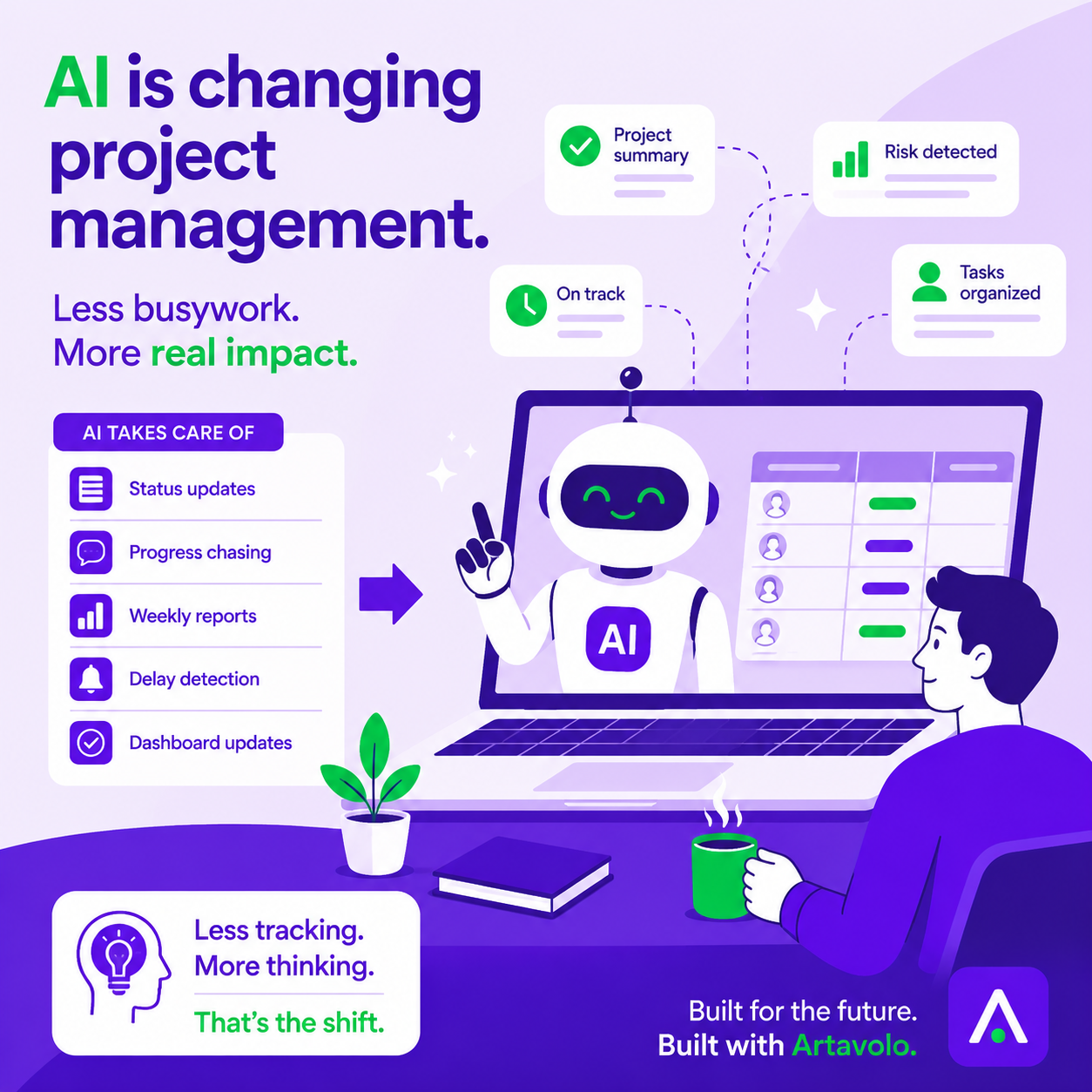
- Auto-summarize project activity
- Turn messy updates into clean reports
- Spot delays before humans notice them
- Suggest priorities based on progress patterns
- Keep dashboards up to date without constant manual input
So instead of people spending hours maintaining systems, the system starts maintaining itself.
That’s the real shift.
What actually changes for teams
This doesn’t remove the need for project managers. It removes the “human glue work” they’ve been stuck doing for years.
So the role starts to split:
Less of:
- chasing updates
- formatting reports
- manually tracking everything
- running endless status meetings
More of:
- deciding what matters
- resolving trade-offs
- aligning stakeholders
- making judgment calls when things get messy
In other words, fewer admin tasks, more actual thinking.
Where tools like Artavolo come in
This is where tools like Artavolo fit into the picture.
Instead of being just another task board, it’s built more like a structured workspace—think tables that behave like a mix of spreadsheet and database, but designed for teams.
That matters a lot in an AI-driven workflow.
AI works best when the data is clean and structured. When tasks, owners, deadlines, and dependencies all live in a consistent format, the system can actually do something useful with it.
In setups like Artavolo, AI can:
- Turn raw project data into summaries instantly
- Reorganize tasks based on priority or status
- Highlight risks or delays without someone manually checking
- Help generate clearer breakdowns from high-level goals
So instead of AI sitting “on top” of messy workflows, it works with a structured system underneath.
That’s the difference.
The uncomfortable truth people keep misunderstanding
When people say “AI is replacing project managers,” that’s usually not accurate.
What’s actually happening is simpler:
AI is removing the low-value parts of the job.
The things that disappear first are:
- coordination overhead
- manual tracking
- repetitive communication
- administrative reporting
What becomes more important:
- decision-making
- context understanding
- leadership
- prioritization under uncertainty
So it’s not fewer people. It’s fewer people doing low-leverage work.
Where this is heading
Project management is slowly shifting from:
“keeping everything updated”
to
“designing systems that mostly keep themselves updated”
That’s a big mental shift.
Tools like Artavolo are part of that direction—less about managing tasks manually, more about creating structured environments where AI can actually help instead of just observing.
AI isn’t killing project management.
But it is killing a lot of the busywork that used to come with it.
And what’s left is either:
- the interesting part of the job
or - the part where real decisions actually get made
Depending on how you look at it, that’s either a threat or a long-overdue upgrade.