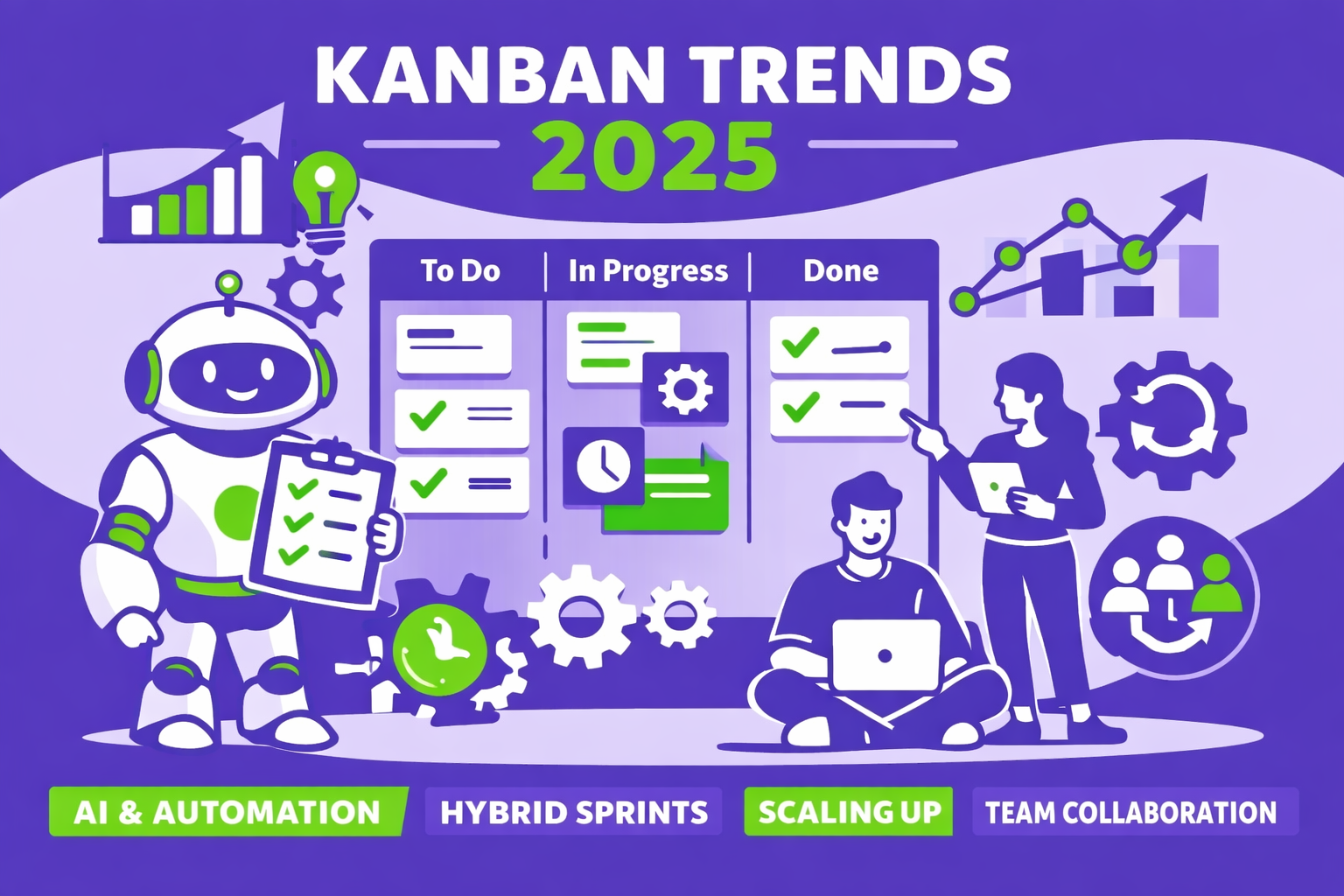
Kanban has been a cornerstone of visual workflow and task management for teams around the world. Originally developed in manufacturing and later popularized in software development, Kanban continues to evolve — surfacing smarter, faster, and more collaborative ways to manage work.
In 2025, we’re seeing a fresh wave of trends that extend Kanban beyond traditional boards and workflows, integrating modern tools, AI, and team-centric practices to empower productivity like never before.
What Is Kanban?
Kanban is a visual framework for managing work as it moves through a process — typically represented as columns on a board (e.g., To Do → In Progress → Done). It helps teams visualize tasks, limit work-in-progress (WIP), and optimize workflow to increase efficiency and reduce bottlenecks.
- AI-Powered Kanban Assistants
- AI-Powered Kanban Assistants
Artificial intelligence is no longer a futuristic idea — it’s actively transforming Kanban boards:
-
Automatic task categorization
AI analyzes titles and descriptions to assign priorities, labels, or even estimates. -
Smart workflow predictions
AI alerts teams when tasks are likely to cause bottlenecks, based on historical cycle time and WIP trends. -
Contextual suggestions
AI suggests next steps or related tasks to reduce guesswork.
For example, tools like Artavolo use AI to surface task insights, recommend dependencies, and auto-prioritize cards, helping teams work smarter rather than harder.
Takeaway: AI turns Kanban boards into proactive partners for work planning.
2. Hybrid Kanban + Sprint Frameworks
Pure Kanban is incredibly flexible, but many teams are blending it with agile practices like Scrum sprints to gain predictability without losing flow.
This hybrid approach typically involves:
-
Maintaining a Kanban board for task flow
-
Adding time-boxed planning and review cycles (e.g., weekly sprints)
-
Tracking both flow (throughput, cycle time) and time-boxed commitments
Teams using hybrid models report improved visibility and better alignment between planning and execution.
3. Scaling Kanban Across Organizations
Kanban is no longer just a team-level tool. Enterprises are using multi-team boards and portfolio Kanban to:
-
Coordinate across departments
-
Visualize strategic initiatives alongside daily work
-
Track OKRs or long-term goals through visual flows
These scaled Kanban systems often include shared swimlanes for cross-functional initiatives and automated roll-ups of work progress.
Benefit: Better alignment from individual contributors to executive goals.
4. Data-Driven Kanban Metrics
Modern task management tools provide far more than a static board. Teams are now embracing analytical dashboards to unpack:
-
Throughput trends — how many tasks complete in a given period
-
Cycle time histograms — how long work spends in each stage
-
WIP heatmaps — where work tends to stall
Tools with built-in analytics allow teams to run real retrospective meetings backed by data—not opinions.
5. Collaboration Beyond the Board
Kanban boards are becoming more integrated with communication tools:
-
Real-time chat inside cards
-
Collaborative task commenting with @mentions
-
Live status updates when team members make changes
This transforms the Kanban board from a static visualization to a collaborative work hub, pulling together discussions, documents, and decisions in one place.
6. Dynamic Work-in-Progress (WIP) Limits
Traditional Kanban sets static WIP limits for columns. Next-gen boards now offer adaptive WIP limits that change based on:
-
Team capacity
-
Historical throughput
-
Task complexity
Adaptive WIP helps teams avoid overload without manual tweaking, keeping the workflow balanced even as conditions change.
7. Personal Kanban Meets Focus Work
Individuals and knowledge workers are adopting Personal Kanban to balance productivity with well-being:
-
Personal boards reflect daily priorities — not only team priorities
-
Focus columns (e.g., Focus, Blockers, Waiting on Input)
-
Visual cues for energy levels or estimated effort
This trend is helping knowledge workers tame distraction and manage attention as a resource.
8. Automation Rules Within Kanban
Automation is leveling up Kanban with triggers like:
-
Move a card when a checklist is complete
-
Open a blocker ticket when a due date slips
-
Notify stakeholders when cycle time crosses a threshold
Rule-based automation saves teams from repetitive tasks and ensures consistency without manual overhead.
9. Cross-Functional Team Boards
Instead of separate boards for design, development, testing, and support, more teams are embracing shared cross-functional boards that:
-
Highlight handoffs clearly
-
Prevent backlog silos
-
Increase shared ownership of goals
Teams report smoother coordination and faster end-to-end delivery with this approach.
Kanban is no longer a static “columns and cards” solution. It’s evolving into a smart, collaborative, adaptive system that supports modern work complexities — from individual focus to enterprise portfolio alignment.
As organizations incorporate AI, automation, analytics, and hybrid agile practices, Kanban becomes a powerful engine for both clarity and performance.